Where It All Began…
“The Pervasiveness and Persistence of the Feminine Beauty Ideal in Children’s Fairy Tales” by Lori Baker-Sperry and Liz Grauerholz
Throughout time, especially in the 20th century (as the article focuses on this time period), beauty has remained a rather vital aspect of the ways women are portrayed in literature and nearly every other aspect of life. It is said that these perceptions of beauty result in political and social effects, which ultimately amount to power. The importance of this article exists in its ability to outline the foundations for the stereotype the Park resists. Baker-Sperry writes, “…it is women’s beauty that is emphasized in terms of the number of references to beauty, the ways it is portrayed, and the role feminine beauty plays in moving the story along” (Baker-Sperry, 719). With this being said, the female idea of beauty has the potential to drive forth an entire story, and contrastingly, it also has the potential to be powerless if the character is not deemed beautiful by societal standards. Beauty, behavior, and temperament are all associated with how female characters are perceived, and often determining whether they are rewarded or punished.
Baker-Sperry, Lori, and Liz Grauerholz. “The Pervasiveness and Persistence of the Feminine Beauty Ideal in Children’s Fairy Tales.” Gender & Society, vol. 17, no. 5, Oct. 2003, pp. 711–726, doi:10.1177/0891243203255605.
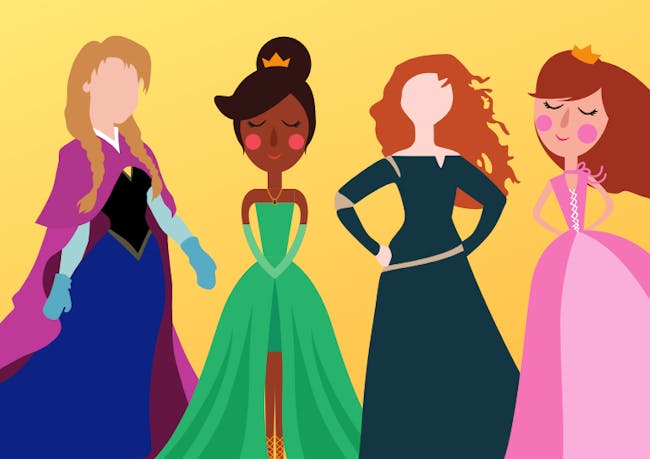
retrieved from https://www.miltontheatre.com/e/princess-tea-61258603131/
…and how it has evolved
“Gender Representation in Children’s Literature: 1900-1984” Elizabeth Grauerholz and Bernice A. Pescosolido
According to Grauerholz and Pescosolido, the movement toward gender equality among female characters in culture and literature started as a result women becoming more and more commonly found in the workplace during times of war. This article argues that children’s literature represents social conditions “at a substantial lag” (Grauerholz and Pescosolido, 123). Later the article argues that women were not actually represented with any significance until the 1950s, which marks the point at which the idealistic family stereotype problematically emerged. The stay-at-home wife with a husband and children was the standard at the time, and it was reflected in literature as well. Along with this stereotype, the social culture of the youth also began to change. Various forms of media (magazines, television, news, etc.) acknowledged these shifts, and from there, women more commonly became represented. The context of this representation has obviously evolved, but it had to start somewhere.
Grauerholz, Elizabeth, and Bernice A. Pescosolido. “Gender Representation in Children’s Literature: 1900-1984.” Gender and Society, vol. 3, no. 1, 1989, pp. 113–125. JSTOR, www.jstor.org/stable/190043.
 Barbara Park's Literary Legacy